Generational change on the construction site: When the foreman retires and the expertise leaves with him
By 2036, more than 20 million workers in Germany will retire from the workforce. With them, practical experience and know-how that no manual can capture will disappear. Why this will hit industry harder than any skilled labor shortage.
The number no one can ignore
By 2036, more than 20 million workers in Germany will retire from the workforce — over 30 percent of today’s labor market. In mechanical engineering alone, around 296,000 employees will retire over the next ten years, while only about 118,000 new workers will enter the field. According to a recent study by the German Economic Institute, this leaves a gap of up to 178,000 skilled workers. In the technician and electrician categories, the shortage rate is already at 34 and 43 percent respectively.
These figures are alarming enough. But they describe only one half of the problem — the quantitative side. The other half is harder to measure and therefore far more dangerous: every experienced employee who retires takes with them knowledge that exists in no database, is documented in no manual, and cannot simply be replaced through a job posting.
What cannot be documented is lost
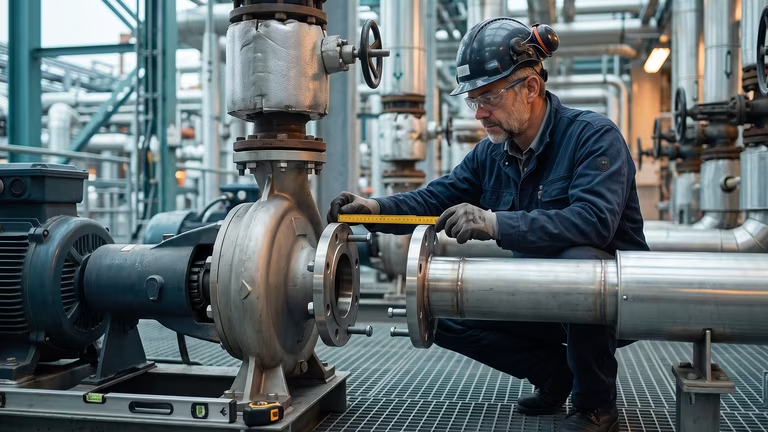
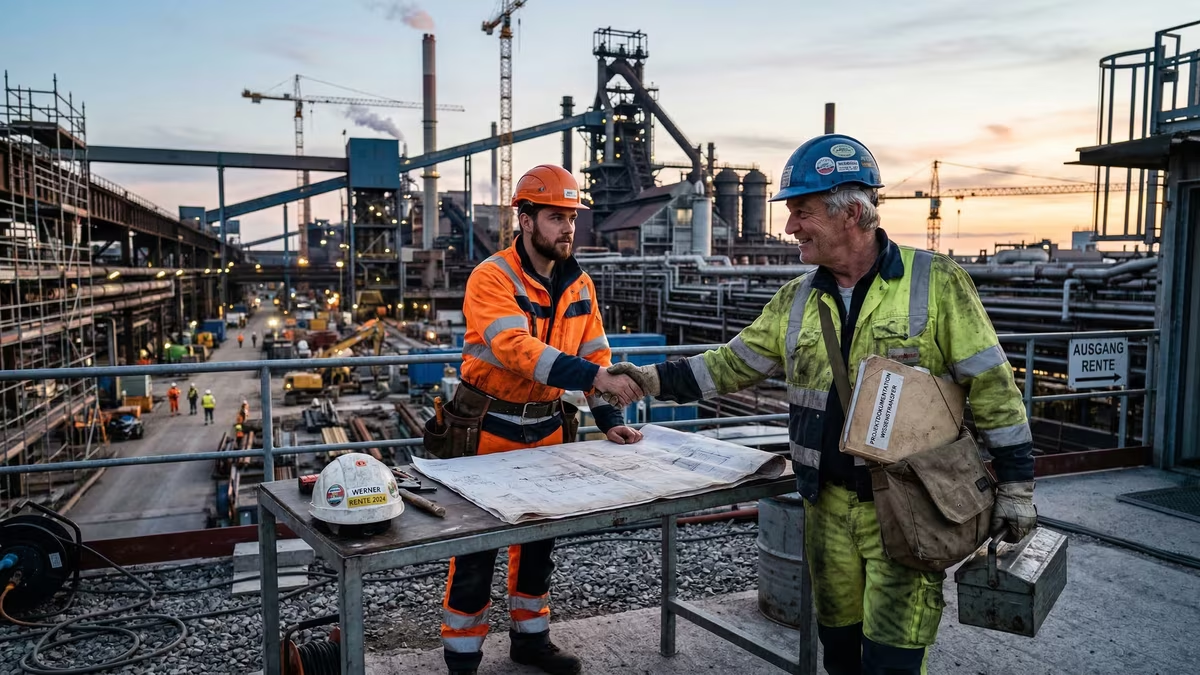
When a foreman packs up his tools for the last time after 30 years in plant construction, he takes something with him that no organizational chart can capture. He knows which valve in Block 3 sticks during winter and how to keep it sealed anyway. He can tell from the sound of a pump whether it will fail in three weeks. He knows which supplier to call when something becomes urgent at 6 p.m. on a Friday evening — and which ones to avoid. This experiential knowledge — referred to by experts as implicit or tacit knowledge — is the result of decades of practical experience, thousands of solved problems, and countless situations in which someone made the right decision without being able to explain why.
A study by document management specialist Kyocera shows that not even half of employees in Germany and Austria perceive knowledge sharing within their companies as structured. In other words, most businesses simply lack a reliable process for transferring experiential knowledge before it leaves the company. The German Association of Small and Medium-Sized Businesses estimates the cost of losing implicit knowledge at up to 2.5 annual salaries per departing knowledge holder — and this does not even include the downstream costs of poor decisions, repeated mistakes, and lost customer relationships.
The gap no job posting can fill
The reflex of many companies is understandable: advertise vacancies, recruit faster, increase salaries. But this approach falls short because it addresses only the labor shortage, not the loss of knowledge. Even if every vacant position could be filled immediately, the new employee would still face a learning curve that takes years without proper guidance.
Boeing provided a prominent example: when production of the 737 was ramped up, the company had to bring back hundreds of already retired mechanics and engineers because critical knowledge about assembly processes had retired with them, and the remaining workforce was unable to resolve production issues. In the process industry, the consequences are just as tangible. A Siemens report shows that recovery times after unplanned shutdowns have increased by 60 percent over the past five years — a direct indicator that experiential knowledge once taken for granted is now missing.
You notice it on the jobsite first
In manufacturing and plant construction, the generational shift hits particularly hard because experiential knowledge is not merely helpful here — it is often safety-critical. When the experienced inspector retires who could instantly tell whether the sealing surface on a flange connection was still acceptable, his successor first has to develop that eye over years of experience. When the site manager is missing who knew from experience in which sequence trades needed to be coordinated to avoid delays, a smooth workflow suddenly turns into an expensive mess.
In surveys, 78 percent of manufacturing companies state that they are seriously concerned about the so-called brain drain caused by retiring employees. More than 60 percent of surveyed engineers describe the loss of so-called tribal knowledge — informal knowledge passed on verbally — as one of the most significant problems within their organizations. And yet very few companies are taking systematic action against it.
Why traditional handovers fail
Most companies rely on traditional onboarding: the experienced employee shows the new one how things are done. This principle works as long as there is enough time available and both sides are willing and able to transfer knowledge. In practice, these conditions are rarely met. During their final months, departing employees are often fully occupied with day-to-day operations and have no capacity for structured knowledge transfer. Frequently, the successor has not even been hired yet when the predecessor leaves — in many cases, there is a gap of weeks or months between the last working day of one and the first of the other, during which the knowledge is simply inaccessible.
Added to this is the nature of experiential knowledge itself. Someone who has maintained a plant for 25 years often cannot even articulate what they know. They act intuitively, recognize patterns subconsciously, and make decisions based on experiences they themselves have long forgotten. Asking them to write this knowledge into a document is about as promising as asking a concert pianist to capture their skill set in an instruction manual.
What works instead
The companies that manage generational change better than others have one thing in common: they do not wait until the employee gives a farewell speech, but systematically build structures that make experiential knowledge independent of individuals.
It starts with the digital documentation of workflows — not as a one-time project, but as an integral part of daily work. When every relevant decision, every deviation from standard procedures, and every problem solution is digitally recorded, a knowledge base develops over time that does not leave the company with any single employee. This is not about bureaucratic forms, but about low-threshold tools — mobile data capture on site, photo documentation with contextual information, structured checklists that simultaneously serve as a knowledge source for the next person.
The second lever is the interconnection of information. Experiential knowledge loses its value when it exists in isolation inside the minds of individual employees. But when the maintenance history of a plant, the inspection results from the last ten years, and the foreman’s informal notes all converge in one place and are accessible to every authorized person, individual knowledge becomes organizational knowledge. The new technician no longer needs to call the retired colleague — the information is available in the system.
And finally, real-time transparency helps shorten the learning curve for new employees. When an inexperienced technician can immediately see which work has already been carried out on a system component, which irregularities have been documented, and which decisions were made in the past, they can make sound decisions more quickly instead of starting from zero.
Time is running out
Demographic change is no longer a forecast — it is reality. The youngest baby boomers retired in 2024, and the wave of departures will continue to accelerate in the coming years. Companies that fail to create structures now for preserving and making experiential knowledge accessible will not feel the consequences in five years’ time, but during every turnaround, every disruption, and every critical decision where the experienced colleague who once knew exactly what to do is no longer there.
The skilled labor shortage cannot simply be solved through recruitment. But the loss of knowledge can be stopped — if action begins today.
Sources:
- IW Cologne: 178,000 skilled workers missing in mechanical engineering by 2034
- ManpowerGroup: Skilled Labor Shortage Study 2025
- DIHK Skilled Labor Report 2024/2025
- ingenieur.de: Knowledge loss due to baby boomer retirement
- KNOWRON: Skilled labor shortages and baby boomer retirement — statistics and trends
- Plant Engineering: Aging Workforce – How Will Companies Cope?
- FP360: The Industrial Brain Drain – Knowledge Gaps in Manufacturing
- Korra: Economic Impact of Knowledge Loss Due to Aging Workforce