AI in Piping Construction
Everyone is talking about AI. In pipeline construction, very little is happening — even though hardly any industry is as document-heavy, as dependent on experiential knowledge, or as affected by the shortage of skilled workers. A look at what needs to change.
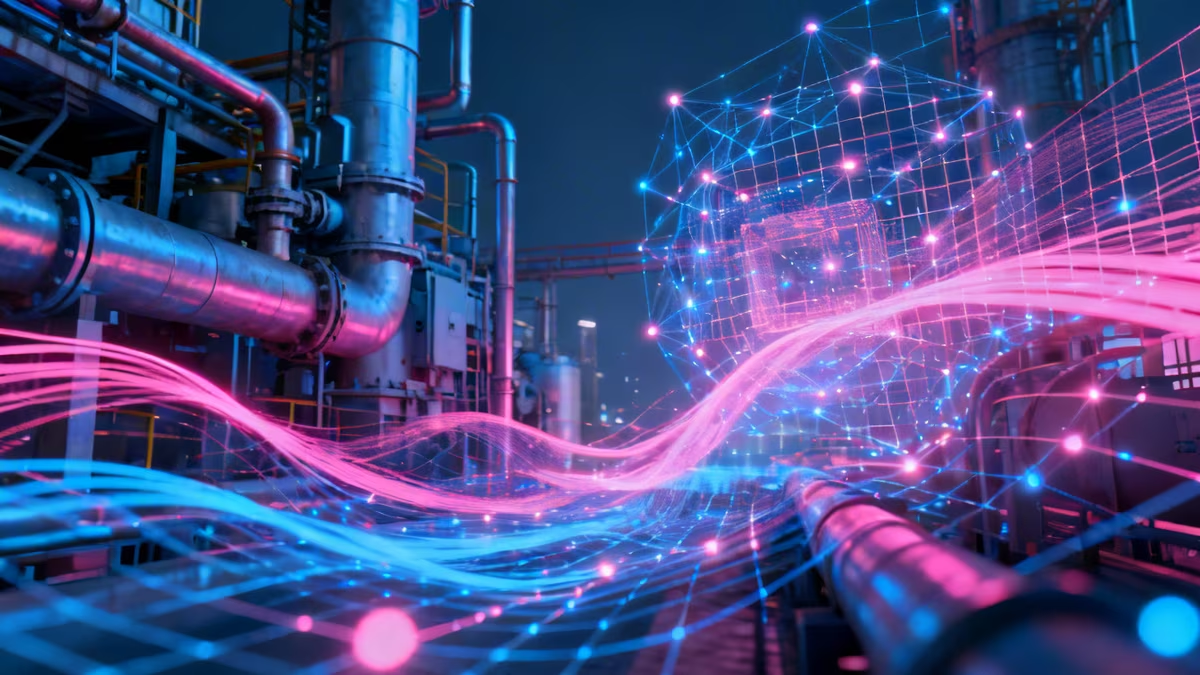
AI is everywhere — except on construction sites
In almost every industry, people are talking about what AI will change. In software development, it writes code; in marketing, it writes copy; in medicine, it analyzes imaging data. In pipeline construction? Many things are still done the same way they were twenty years ago. Not because people are outdated — but because the conditions are different.
In plant engineering, it’s about pressure equipment, safety-critical systems, and standards such as PED 2014/68/EU, AD2000, or ASME. Nothing here can be approximately correct. And that’s exactly what makes the use of AI more difficult — but not impossible. Quite the opposite.
The problem is not the technology. It’s the context.
Most AI applications work well when the task is clearly defined: recognize images, summarize text, identify patterns. In pipeline construction, tasks are rarely clearly defined. A material certificate looks different from every manufacturer. An isometric can be hand-drawn or exported from a 3D model. A pipe class sheet follows internal company conventions that are documented nowhere.
AI does not fail because it is too unintelligent. It fails because it lacks the context that an experienced pipeline engineer has in mind. And this is exactly where things get interesting: because that context can be digitized — if you know where it resides.
Experience-based knowledge is disappearing. And quickly.
The skilled labor shortage in plant engineering is no longer a forecast — it is reality. Experienced welding engineers, field measurers, QA managers, welders, and fitters are retiring. Their years of accumulated know-how — such as why a lap joint flange is better than a weld neck flange at a specific point — disappears with them.
This is not a problem that can be solved with job ads. It is a problem that can only be solved when the knowledge resides in the system instead of in the minds of individual people. And that is exactly what AI can do — not by making decisions, but by making relationships visible that otherwise only the experienced colleague understands.
Where AI actually helps in pipeline construction
Not where it makes decisions. But where it takes over the tedious, error-prone work that consumes hours today:
Understanding documents. Reading a material certificate, extracting the relevant values, matching them against the purchase order, and assigning them to the correct component. This is not creative work — but it requires concentration, and mistakes are expensive. AI can do this faster and more consistently than any human. Not better in every individual case — but more reliably across hundreds of documents.
Recognizing patterns. Which materials are repeatedly reordered because the initial delivery does not meet specifications? Which supplier’s certificates regularly deviate from the ordered values? These are questions that a project manager can answer intuitively after twenty years in the business. Everyone else needs data — and someone to analyze it. Or simply AI.
Checking plausibility. Does the pipe class match the medium and the pressure? Are all weld seams documented? Is a material certificate missing for a component on the critical path? These are checks that are performed manually today — often shortly before the audit and often under time pressure. AI can run them continuously in the background as silent quality assurance.
Creating pipeline documentation. Compiling documentation — piping books, welding records, material overviews, inspection certificates — consumes hours on every project. Yet most of this work is rule-based: which certificate belongs to which component, which weld seam requires which verification, which inspections are required for which pressure class. This does not even require AI — 90% of this documentation can be generated automatically if the data is properly maintained in the system. No interpretation required, just assignment according to clear rules. Nevertheless, in most projects today it is still done manually.
Why GDPR and data sovereignty do not have to be an excuse
A common objection: "We can’t just send project data to the cloud." The objection is justified. Material certificates contain supplier data, project data, and sometimes even customer-specific specifications. That does not belong on a US server.
But AI does not automatically mean cloud. Modern language models run on European servers, OCR engines can operate entirely on-premise, and document analysis does not require internet access. The question is not whether AI can be used in compliance with data protection regulations — but whether companies are willing to do it.
What needs to change — and what doesn’t
AI will not replace the welder, the field measurer, or the project manager in pipeline construction. It will replace the work nobody enjoys doing: typing out certificates, compiling bills of materials, searching for documents, reconciling data.
And it will enable something that previously required extensive experience: maintaining oversight. Across hundreds of components, thousands of documents, and dozens of suppliers — in real time, not just during the audit.
The industry that would benefit most from AI is the one struggling with it the most. Not because it doesn’t need it — but because the barrier is higher than elsewhere. But that is exactly why the advantage is even greater once you get started.