Checklist: Getting Started with Digitalization in Pipeline Construction
The practical checklist for getting started with digitalization in pipeline construction – from initial assessment to rollout. 20 concrete action points to tick off.
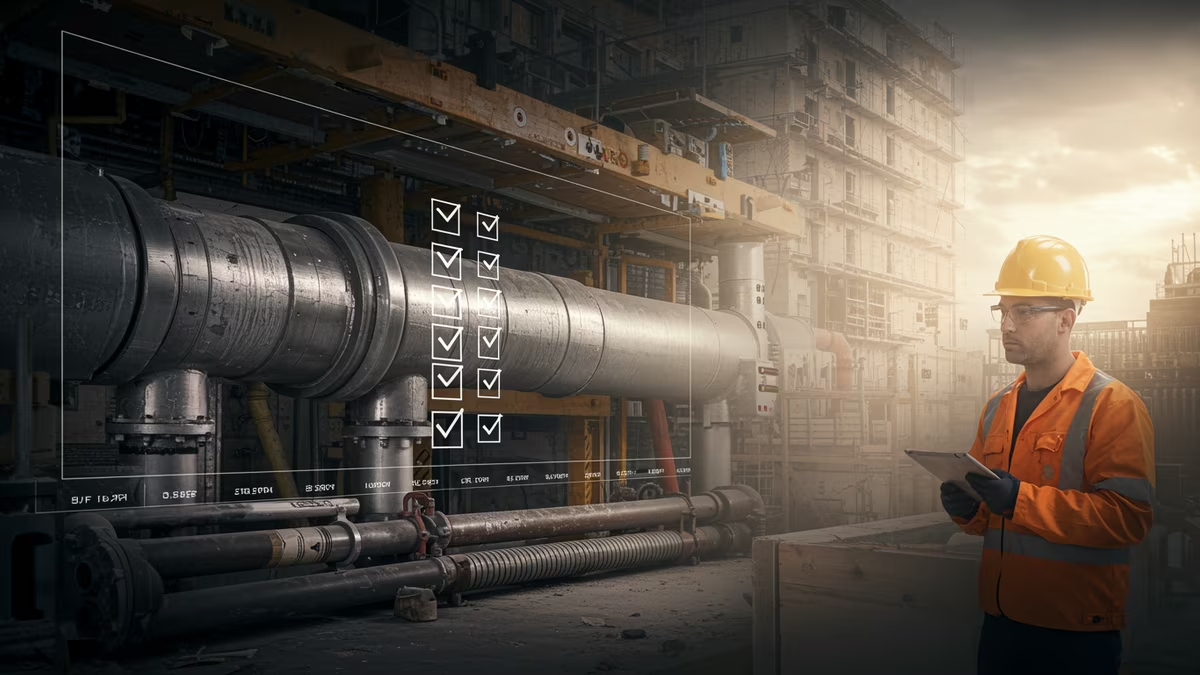
Checklist: Getting Started with Digitalization in Piping Construction
Digitalization in piping construction sounds like a major project. But it doesn’t have to be.
In our recent articles, we showed where Excel reaches its limits in piping construction and how AI can specifically help with document analysis, pattern recognition, and plausibility checks. But there is often a gap between “we should digitalize at some point” and actually getting started. This checklist closes that gap.
No theoretical white paper, no consultant jargon. Just 20 practical points you can check off — step by step.
Phase 1: Assessment – Where do you stand today?
Before introducing a new tool, you need to know what you are replacing. Sounds obvious, but it is regularly overlooked.
☐ Count your Excel files How many spreadsheets are currently circulating in your project? For material lists, certificate tracking, inspection status, weld documentation? If the answer is “more than five,” you have a fragmentation problem — exactly what we described in our article on the five Excel warning signs .
☐ Map the document flow Draw out how a material certificate currently moves through your company. From incoming email to filing and assignment to the installation position. Where is data manually retyped? Where are files duplicated? Where does the chain break down?
☐ Identify time drains Ask your project managers and QA staff: “What takes up most of your time that could actually be automated?” The answers are almost always: certificate management, report generation, and data reconciliation between departments.
☐ Evaluate compliance effort How long does it currently take to compile all documentation for a component during an audit? Anything over 10 minutes per item is a sign that your documentation is not structured enough. With requirements under PED 2014/68/EU and EN 10204, this is not a minor issue.
☐ Identify key knowledge holders Who on your team knows the Excel systems inside out? If only one or two people understand how everything fits together, you have a risk — exactly the knowledge drain problem that also plays a central role when it comes to AI in piping construction.
Phase 2: Set Priorities – Where to start?
The biggest mistake in digitalization: trying to do everything at once. Start where the pain is greatest and the benefits become visible the fastest.
☐ Choose one pain point Not three, not five. One. For most piping construction companies, this is EN 10204 material certificate management — because it is time-consuming, error-prone, and audit-relevant.
☐ Define a pilot project Choose a medium-sized project that is already running or about to start. Not a massive project where everything has to run perfectly. But also not a tiny job where the impact disappears.
☐ Build a small pilot team 2–3 people are enough: one project manager, one QA employee, and someone from procurement. Ideally, people who are open to change — not the skeptics. You can convince them later with results.
☐ Define success What needs to be better after 4 weeks for you to say “this was worth it”? Be specific and measurable. For example: “Certificate management takes 50% less time” or “Every certificate can be found in under 2 minutes.”
Phase 3: Choose the Tool – What should you look for?
Not every software solution fits piping construction. Generic project management tools cover the basics but do not understand pipe classes, isometrics, or material certificates.
☐ Check for industry-specific functionality Can the software handle pipe classes, isometrics, and material certificates — or do you have to configure everything yourself? A platform that speaks your language saves weeks of setup time.
☐ Test mobile usability Does the solution work on-site? On a tablet, with a slow connection? If the field installation team gains nothing from it, you are missing half the value.
☐ Evaluate AI features Can the system automatically recognize and extract documents? As described in our AI article: the most impactful AI applications in piping construction are document analysis, plausibility checks, and automated report generation. Check whether the solution offers this — and whether the data remains in the EU.
☐ Ensure compliance capability Does the software support seamless audit trails? Can it map traceability from purchase order through delivery to installation position? This is not a nice-to-have, but a requirement for pressurized systems.
☐ Check the entry barrier Is there a free entry option or trial phase? Do you need to hire a consultant before you can even get started? The lower the barrier to entry, the faster you will know whether it fits.
Phase 4: Implementation – The First 30 Days
☐ Import an existing project Transfer the materials and certificates from your pilot project into the new platform. Not your entire database — only the current project. That is enough to experience the added value.
☐ Test AI-supported capture Upload 10–15 material certificates and check how well the automatic recognition works. Are heat numbers, material designations, and test results correct? How much manual rework is required?
☐ Involve the construction site Give the site manager access via the mobile app. Let them retrieve isometrics, check inspection status, and view documentation on-site. Feedback from the construction site is the fastest way to see whether the solution works in daily operations.
☐ Collect weekly short feedback 10 minutes per week with the pilot team. Three questions are enough: What works well? What is annoying? What is missing? Document the answers — they will help during the later rollout.
Phase 5: Evaluate and Scale
☐ Measure results Compare the effort before and after the transition. How long does certificate management take now? How quickly can you find a document? Numbers convince people — including management.
☐ Plan the rollout If the pilot project works, define the next step. Which team will join next? Which project types will be converted first? Step by step, not all at once.
Conclusion: Just get started
Digitalization in piping construction is not an IT project that requires months of preparation. It is a decision you can make tomorrow — if you start small enough.
Take one project. One team. One pain point. And test for 30 days whether an industry-specific
solution makes the difference.
Ready for the first step? Try paipe — including AI-supported certificate management and mobile construction site connectivity.