Native-language instruction: From a ticked attendance box to verified proof
Safety briefings on site are conducted in German – but they are often not actually understood. A signature then merely confirms attendance, not comprehension. How instruction in the worker’s native language combined with genuine knowledge assessment turns this into a reliable, verifiable record.
When Half the Crew Just Nods: Why Construction Site Safety Briefings Fail Because of Language
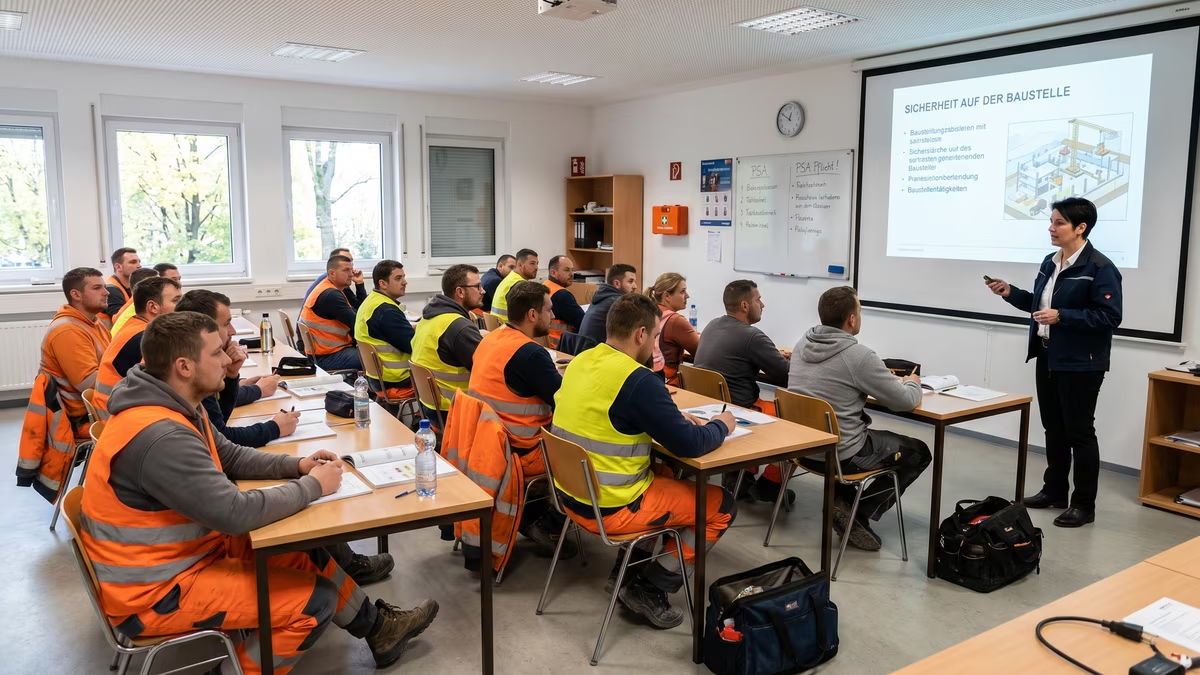
It’s 7 a.m. on the construction site. A new crew arrives – your own people, plus two subcontractors and a temporary worker nobody knows. Before anyone picks up a tool, climbs into the trench, gets on the scaffold, or is allowed near the pipeline, one thing comes first: the safety briefing. And it drags on for hours before anyone can start work. Escape routes, PPE, gas alarms, trench shoring, fall protection, hot work – the site manager scrolls through the PDF and reads out every point while the crew sits in the site container waiting.
This is not optional – it is mandatory. Under Section 12 of the German Occupational Health and Safety Act (ArbSchG) and DGUV Regulation 1 (“Principles of Prevention”), every employee must receive a safety briefing before starting work and then regularly thereafter, at least once a year. The briefing must be documented – and on construction sites, project-specific hazards are added on top. Nobody can skip it. The question is not whether a briefing takes place, but whether anything actually gets through in the end.
The real problem: the briefing is held in German – but nobody understands it
Take a look at the crew. German, Polish, Romanian, Bulgarian, Ukrainian, Turkish – and sometimes even more languages within a single team. But the briefing is conducted in German, verbally or as a PDF. A large proportion of the workforce simply does not understand the content. They nod because everyone else nods. At the end, the signature sheet goes around, everyone signs their name, and the document disappears into a folder.
This is exactly where things break down. A signature on a briefing that was not understood proves only one thing: attendance. It does not prove comprehension. But the law does not require someone to merely sit through the briefing – it requires that the briefing is actually understood. For foreign-language employees, this specifically means: in a language they understand.
A briefing that is not understood therefore becomes two things. First, it is not reliable proof – the signed list does not hold up to what it is supposed to prove. Second, and more importantly, it becomes a real safety risk. Anyone who does not understand what to do during a gas alarm, how trench shoring works, what fall protection means, or which rules apply to hot work is at risk – and puts others at risk as well. And in the event of an incident, the safety risk turns into a liability issue.
The other friction points – real, but secondary
Beyond the language barrier, several other issues drain time and energy throughout the day. Safety briefings are time-consuming: the site manager stands at the front for hours reading slides instead of building. With changing crews, the process often starts all over again every Monday. The annual mandatory refresher training is tracked in Excel and easily slips through the cracks if nobody keeps an eye on it. And during audits – SCC, customer, or trade association – the records have to be painfully pulled from folders and matched against lists. Annoying, yes. But the core problem remains: a briefing nobody understands is not a briefing.
How pAIpe does it differently: in the employee’s native language, with real knowledge verification
The key difference starts exactly at the language barrier. With pAIpe, every participant selects their own language, and the content is automatically translated – into multiple languages: German, English, Polish, Romanian, Hungarian, Bulgarian, Czech, Croatian, Slovak, Italian, Turkish, and Ukrainian. The Polish pipefitter reads the briefing in Polish, the Romanian installer in Romanian.
The second lever: instead of a signature sheet, there is a real knowledge assessment at the end. A quiz with single-choice and multiple-choice questions, a configurable passing threshold (for example 80 percent), randomized questions, and a limited number of attempts. Only those who pass have completed the briefing. This turns “was present” into “understood” – the proof of comprehension that paper could never provide.
The process: magic link instead of container sessions
The briefing is sent via magic link, completely without login credentials – either to your own employees or directly to an external contractor. Each distribution includes a reusable campaign link. The subcontractor forwards it internally, and every employee completes their own briefing – before the first day on site, on their own smartphone. The site manager no longer has to stand at the front for hours on Monday morning.
For identification, the participant enters their name; external contractor employees additionally provide their date of birth and ID card number – clearly confirming who completed the briefing, rather than merely showing that someone ticked a box.
From passed quiz to auditable proof
Anyone who passes automatically receives a certificate as a PDF, issued in the company’s language. It is automatically integrated into the digital SCC passport (safety passport). When an external contractor employee passes, they are automatically created as an employee of their company and also receive an SCC passport containing this briefing.
Every certificate includes a QR code and can be publicly verified through it. At the plant gate or during an audit, it can be checked within seconds: authentic? still valid? No digging through folders, no Excel cross-checking.
The overview changes as well. For each campaign, it is immediately visible who participated, who passed, with what result – and who is still missing. Validity is stored as a date, so annual refresher training no longer slips through the cracks.
What pAIpe does not do
One thing is important: pAIpe does not eliminate the legal obligation and does not replace any site-specific induction that may still be required on location. What pAIpe does is move the standardizable part – basic and mandatory briefings, recurring topics – away from the construction site morning routine and make compliance efficient, multilingual, and verifiable.
At the core, it all comes down to language. As long as a large part of the crew only nods and signs, you may have a list, but you do not have safety. Offering the briefing in employees’ native languages and verifying comprehension at the end changes that completely: a simple attendance checkmark becomes a reliable, verified record – for safety on the construction site and for the day the audit arrives.