Product
Legally robust documentation: Why your construction log only proves its true value when a dispute arises
In the case of change orders, disruptions and construction schedule disputes, what matters is not what happened, but what can be proven. How the pAIpe construction diary turns many small entries throughout the day into a complete, signed and frozen daily record — legally robust in accordance with…
 AI-generated
It’s 6:40 p.m., it’s getting dark outside, and the last crew has come down from the scaffolding. You’re sitting in the site office trailer, the coffee is cold, and in front of you lies the task you’ve been putting off for weeks: today’s site diary. You try to reconstruct what happened between 7 a.m. and 5 p.m. How many people were up there? Was this the day the crane stood idle for two hours because the delivery couldn’t get through — or was that yesterday? Did the insulation subcontractor provide four workers or three?
What ends up on paper sounds plausible. But at its core, it’s a recollection written ten hours after the fact, filtered through a long day. And that gap between what actually happened and what gets written down in the evening is the real risk on every construction site.
The pain point isn’t the writing — it’s the lack of proof
In a dispute, it’s rarely goodwill that determines who succeeds with a variation claim or gets a project extension approved. What matters is the evidence. And the evidence is almost always the site diary — or precisely the lack of one.
- The disruption no one can prove. Three months later, you’re arguing about a project delay. You know, that the client’s missing approval cost two weeks. But there’s nothing about it in the diary — no disruption notice, no date, no number of hours. In court, what matters is not what happened, but what can be proven.
- The variation claim without substance. Your team performed the additional work — that’s undisputed in your mind. But what’s missing is the complete daily record needed to enforce the claim. “Clearly documented” becomes “open to negotiation”.
- The gap that stands out. Three days without an entry because the pressure was too high. That exact gap is what the opposing side uses to challenge the credibility of the entire diary.
- The document anyone could change. A Word file on the server, a photo folder without dates. In a dispute, the first question is: when was this written — on the same day or afterwards? If a document can be altered without detection, the court will generally not trust it.
These are not writing problems — they are evidence problems. And they arise precisely when documentation is created from memory in the evening instead of in the moment on site.
Capture it when it happens — close it when the day is done
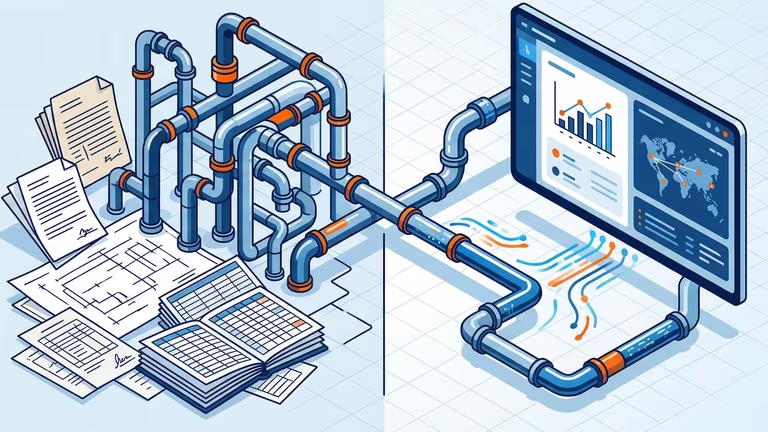
pAIpe turns the process around. Instead of one site manager reconstructing everything alone at the end of the day, the entire team contributes effortlessly throughout the day — right where the work happens. No rigid forms, no training required. In your own language, with pAIpe translating automatically.
The pipefitter records a 20-second voice note on their phone while still standing at the pipe: “Spool 14 welded in, two welds, welders Krüger and Demir.” The forewoman photographs the flooded trench — the photo includes GPS and timestamp data. Someone quickly types: “Flange delivery delayed, delivery note 4471.” The voice note is automatically transcribed, the AI structures it — personnel, work performed, materials, incidents — and all contributions flow live into a daily feed that the project team can see in real time. Capturing information in the field now takes seconds instead of minutes, and the knowledge comes directly from the people who have it.
At the end of the day comes the decisive step. A responsible person consolidates the day: using AI, paipe combines the scattered fragments into one coherent daily report. Duplicate entries are removed, personnel counts from different contributions are correctly aggregated instead of counted multiple times, weather and site conditions are carried over, and employees are matched against master data where possible. Instead of listening to twelve voice notes, you review one completed daily report, correct it, add to it, and finalize it. The AI does not replace human judgment — it organizes the information. The result is a dated report with one responsible person — legally far stronger as evidence than a stack of disconnected individual entries.
What makes the finalization court-proof
When the report is finalized, the technical safeguards that matter in a dispute are applied:
- The PDF is frozen. Once finalized, the day is locked against changes. No one can alter anything afterwards without detection. This creates a clearly defined point in time from which the content is fixed.
- Sequential numbering without gaps. Every day receives a consecutive site diary number per project and year (scheme
BT-2026-0001). A missing number stands out immediately — intentionally so. No one can claim that an inconvenient day “was never documented” when the numbering sequence proves otherwise. - Signature and checksum. The day is signed by the responsible person via signature pad and, if desired, sent to the client. A SHA-256 checksum and signature hash are generated for the content. If even a single character changes, the hash no longer matches — making tampering mathematically verifiable. “Someone wrote something down at some point” becomes “this person took responsibility for this content on this date”.
- Corrections only as addenda. If you discover an error after finalization, nothing is overwritten. Instead, a traceable addendum is attached. The original version remains preserved, and the addendum is clearly identifiable as such — exactly the level of transparency a court expects.
In addition, the system includes the fields that VOB/B and HOAI LP8 require in practice: equipment and machinery on site, subcontractors by trade with hours worked, deliveries linked to delivery notes, inspections and acceptances. And the two entries that often decide real money in a dispute: the disruption notice pursuant to § 6 VOB/B and the notice of concerns pursuant to § 4 para. 3 VOB/B — each as separate, clearly marked entries that can be listed across the project. When the expert asks “When exactly was the disruption reported?”, the system delivers a dated, signed, hash-secured list instead of a frantic search through email inboxes.
A voice-guided gap engine actively prompts for missing mandatory sections. And it also documents deliberate negative confirmations: a recorded “no disruption on this day” has greater evidentiary value than an empty field that can later be interpreted either way.
After finalization, the PDF keeps working
The biggest time drain is often not the writing itself, but filing and retrieving the documents. Both disappear:
- The approved PDF, branded with your company logo, is stored automatically in the project documents. No one has to upload, rename, or move it manually.
- The contents remain searchable in the AI document chat. Instead of searching through twenty PDFs for “when did the flange delivery arrive”, you query the project knowledge directly: “When was Spool 14 welded?” or “What disruptions occurred in May?”
Data is captured in the field via the mobile app, while review, consolidation, and signing happen on the web platform. Because speech is automatically recognized and the report normalized into the project language, your Polish crew can dictate in Polish — while the original transcript remains preserved as evidence.
The difference is decided in the morning, not the evening
A site diary created from memory in the evening is vulnerable in a dispute — no matter how diligently it was written. A site diary built from many small contributions exactly when events occur, and only consolidated, signed, and frozen in the evening, becomes reliable evidence that stands up. Seamless numbering, frozen PDFs, SHA-256 checksums, digital signatures, and addenda transform the site diary from a mere assertion into robust evidence — aligned with the requirements of § 2, § 4, and § 6 VOB/B as well as HOAI LP8.
You save yourself the lonely hour in the site office trailer. More importantly, when it comes to project duration, disruptions, or variation claims, you have exactly what matters in your hands: a complete, dated, signed, and tamper-proof daily record chain.
If your last project delay dispute failed because of missing evidence, it’s worth taking a closer look at the pAIpe site diary. We’ll show you on a real project how the process works — from the first voice note on site to the frozen, signed, and searchable PDF in the project folder — and how much evidentiary strength you regain with it. Get in touch with us.